Inference · Prefill and decode
Inference Runtime
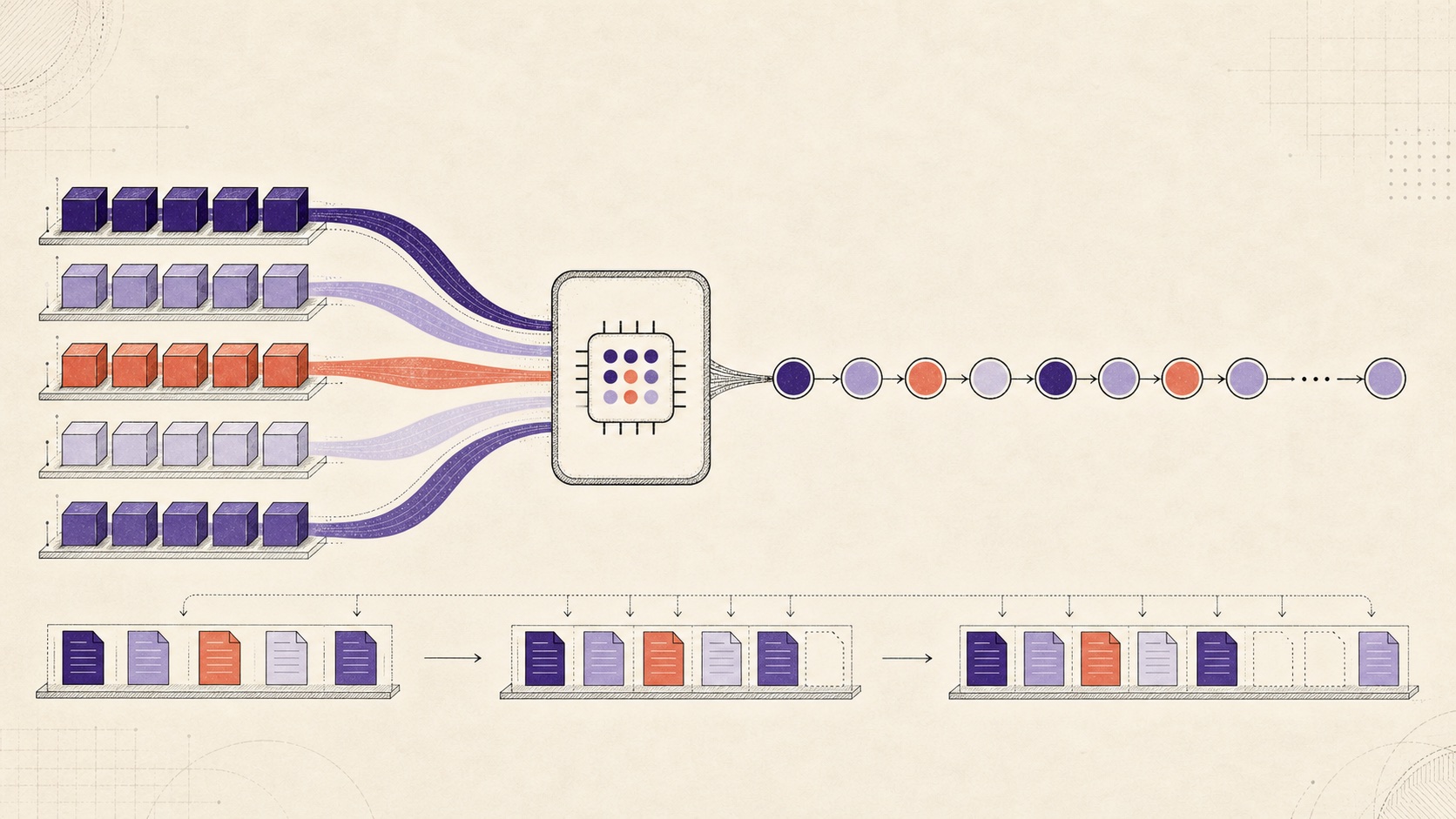
LLM inference handles the prompt in a parallel prefill phase, then decodes one position at a time. The key-value cache grows with the cached sequence positions.
Evidence & limits
- What the further reading establishes
- Paged allocation cuts down on wasted KV-cache space and can raise serving throughput when request lengths vary.
- What this lab runs
- A fixed browser trace lets you inspect prefill, repeated decode, worker isolation, cache growth, and the planned timing for each phase.
- What it does not prove
- This doesn't recreate a GPU kernel, a network of multiple hosts, or a production memory allocator.
Dataset
Inference Trace
- Source
- Course-authored synthetic requests
- License
- Not separately licensed
- Size
- 6 requests · fixed prompt and output lengths
Further reading
- Efficient Memory Management for Large Language Model Serving with PagedAttention
Primary · Woosuk Kwon et al. · 2023
Shows how paged memory connects KV-cache allocation, concurrent requests, and serving throughput.
- FlashAttention
Paper · Tri Dao et al. · 2022
Explains why attention speed depends so much on memory traffic and IO-aware kernels.
- Cache strategies
Guide · Hugging Face Transformers · Current
Covers real KV-cache options, including offloading, quantization, and compile-time tradeoffs.
Lesson progressRestoring progress…
- CodeRestoring
- ExperimentRestoring
- CheckRestoring
Summary
Two phases. Prefill processes every prompt position in parallel, saves the keys and values, and returns the logits used to sample the first output token. To generate N tokens total, the runtime then does max(0, N - 1) one-position decode forwards for the rest.
How memory grows. Every processed sequence position adds one key and one value at each layer. The bytes for one request are 2 × layers × KV heads × tokens × head dimension × bytes per value. With grouped-query attention, KV heads matter here, not query heads.
Keep it off the UI thread. Run browser inference in a Web Worker so the model can't freeze React rendering. Messages give you a clear boundary between product state and model state.
r-104Prompt96 tokensOutput32 tokensFinal length128 tokens- 1Queue
18 ms - 2Prefill
74 ms · 96 positions · 6 KV pages - 3First token
sampled at TTFT 92 ms - 4Decode
31 forwards · tokens 2–32 · 6 → 8 pages - 5Release
8 pages returned
queue + prefill = 18 + 74 = 92 msrequest accepted → first visible tokenITLgap between visible tokenshow quickly one request keeps decodingtokens/s21.4 generated / secondsteady decode rate2 × layers × KV heads × cached tokens × head dimension × bytes / value2 means one key tensor + one value tensor. Under GQA, KV heads may be fewer than query heads.Measure what the user feels. Time to first token (TTFT) runs from admission to the first token on screen, so it includes queueing and prefill. Inter-token latency (ITL) is the gap between later visible tokens. Tokens per second gives the steady decode rate. If you roll all of that into one duration, you lose the shape of the wait the user actually experiences.
Knowledge check
Implementation
Keep generated tokens, model forwards, processed positions, and final sequence length straight.
- Signature
def inference_phases(prompt_tokens, max_new_tokens):- Inputs
- prompt_tokens int ≥ 0, max_new_tokens int
- Returns
- dict[str, int] of prefill, decode, processed, and final counts
- Rule
generated=max(0,N); decode=max(0,generated−1); final=prompt+generated- Example
prompt 96, new 32 → 31 decode forwards and final length 128
Reference solution
Approach Keep generated tokens, model forwards, processed positions, and final sequence length straight.
def inference_phases(prompt_tokens, max_new_tokens): generated_tokens = max(0, max_new_tokens) decode_forwards = max(0, generated_tokens - 1) return { "prefillTokens": prompt_tokens, "generatedTokens": generated_tokens, "decodeForwards": decode_forwards, "processedTokenPositions": prompt_tokens + decode_forwards, "finalSequenceLength": prompt_tokens + generated_tokens, }Build phase accounting and KV-cache sizing in Python, then replay the planned request timeline.
Saved results
Results created after your saved code passes its checks
Saved results
Results created after your saved code passes its checks
The replay is course data. The validation result is tied to the code you saved and checked.
Loading…