Alignment · Additive attention
Additive Attention
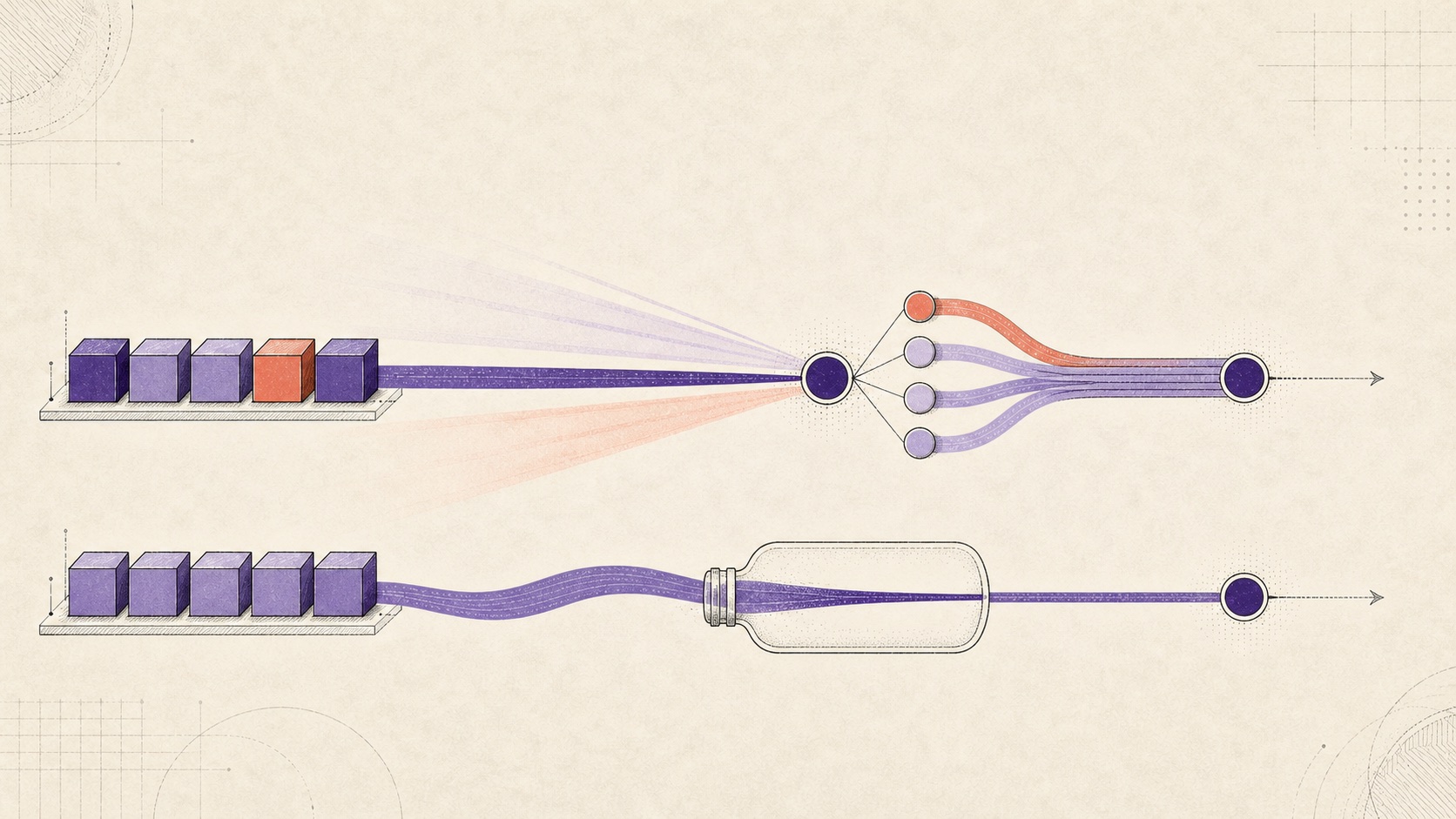
At each output step, the decoder can build a new context vector by learning a soft alignment—how much to focus—over every encoder state.
Evidence & limits
- What the further reading establishes
- Learned soft alignment eases the fixed-length bottleneck in neural translation.
- What this lab runs
- You'll train a real additive scorer to match output roles with the given encoder states and produce a learned heatmap.
- What it does not prove
- This small experiment uses labeled alignment roles instead of the paper's end-to-end translation goal.
Dataset
Date Alignment
- Source
- Course-authored synthetic task
- License
- Not separately licensed
- Size
- 3 semantic roles · 3 fixed alignment cases · 2,000 epochs
Further reading
- Neural Machine Translation by Jointly Learning to Align and Translate
Primary · Dzmitry Bahdanau · Kyunghyun Cho · Yoshua Bengio · 2014
Introduces learned soft alignment so the encoder isn't squeezed into one fixed vector.
- Effective Approaches to Attention-based Neural Machine Translation
Paper · Minh-Thang Luong · Hieu Pham · Christopher Manning · 2015
Compares global and local attention along with several ways to score alignment.
- Show, Attend and Tell
Paper · Kelvin Xu et al. · 2015
Shows soft and hard visual attention at work in an image-captioning model.
Lesson progressRestoring progress…
- CodeRestoring
- ExperimentRestoring
- CheckRestoring
Summary
The fixed-vector squeeze. Without attention, the encoder has to squeeze all n source positions into one fixed vector before decoding starts. The decoder gets that same summary for every output token. That means details needed late in a long sequence have to survive both the initial squeeze and many recurrent updates.
One decoding step. The encoder reads the source sequence and leaves one state h_i at each position. The decoder produces the target one token at a time. Right before output step t, its current state becomes the query q_t, which can look back at every encoder state. In notation, q_t has shape [d_s], and H = [h_1, ..., h_n] has shape [n, d_h]. The same scorer runs n times—once for q_t paired with each h_i—and produces one number e_(t,i) per source position.
Additive score. The score is e_(t,i) = v^T tanh(Wq q_t + Wk h_i + b). Wq and Wk project the query and key into the same attention width d_a. Then tanh combines them, and v turns the d_a values into one number. That's additive attention. A dot-product scorer uses q_t^T h_i instead, with no scoring MLP inside the comparison.
Normalize across positions. For a given t, apply softmax across all n source-position scores: alpha_(t,:) = softmax(e_(t,:)). The weights are positive and add up to 1. In the date task, the row that outputs the year should put most of its weight on the source state for 2026. A large standalone score isn't enough; it has to win against the other positions.
- 1Query
q_year [d_s] - 2Encoder states
H = [h_day, h_month, h_year] [3 × d_h] - 3Additive scores
e = [-1.8, -0.9, 2.4] [3] - 4Alignment
alpha = softmax(e) = [.014, .035, .951] [3] - 5Context
c_year = .014h_day + .035h_month + .951h_year [d_h]
vᵀ tanh(Wq q + Wk h_i + b)learned projections + nonlinear scoreDot productqᵀ h_idirect similarity; not the method used hereBuild the context. The context for this step is c_t = sum_i alpha_(t,i) h_i, with shape [d_h]. Multiply each encoder state by its matching alignment weight, then add the results coordinate by coordinate. The decoder uses c_t for the current output. At the month and day steps, a new query creates new scores, weights, and context. Since every operation is differentiable, the translation loss can train the alignment along with the rest of the model.
Knowledge check
Implementation
Score one decoder query against one encoder state.
- Signature
def additive_score(query, key, parameters):- Inputs
- query [q], key [k], Wq [a × q], Wk [a × k], bias and v [a]
- Returns
- finite float compatibility score
- Rule
e = vᵀ tanh(Wq q + Wk k + b)- Example
q=[1,0], k=[0,1], identity projections, v=[0.5,−0.5] → 0
Reference solution
Approach Score one decoder query against one encoder state.
import numpy as np def additive_score(query, key, parameters): Wq = np.asarray(parameters["Wq"], dtype=float) Wk = np.asarray(parameters["Wk"], dtype=float) v = np.asarray(parameters["v"], dtype=float) bias = np.asarray(parameters["bias"], dtype=float) query_term = Wq np.asarray(query, dtype=float) key_term = Wk np.asarray(key, dtype=float) hidden = np.tanh(query_term + key_term + bias) return float(v hidden)Build one attention step in three separate Python/NumPy cells. First score one query-key pair with the additive MLP. Then run softmax over all source-position scores. Finally, multiply each state by its matching alpha and add the results coordinate by coordinate.
Saved results
Results created after your saved code passes its checks
Saved results
Results created after your saved code passes its checks
The replay is course data. The validation result is tied to the code you saved and checked.
Loading…